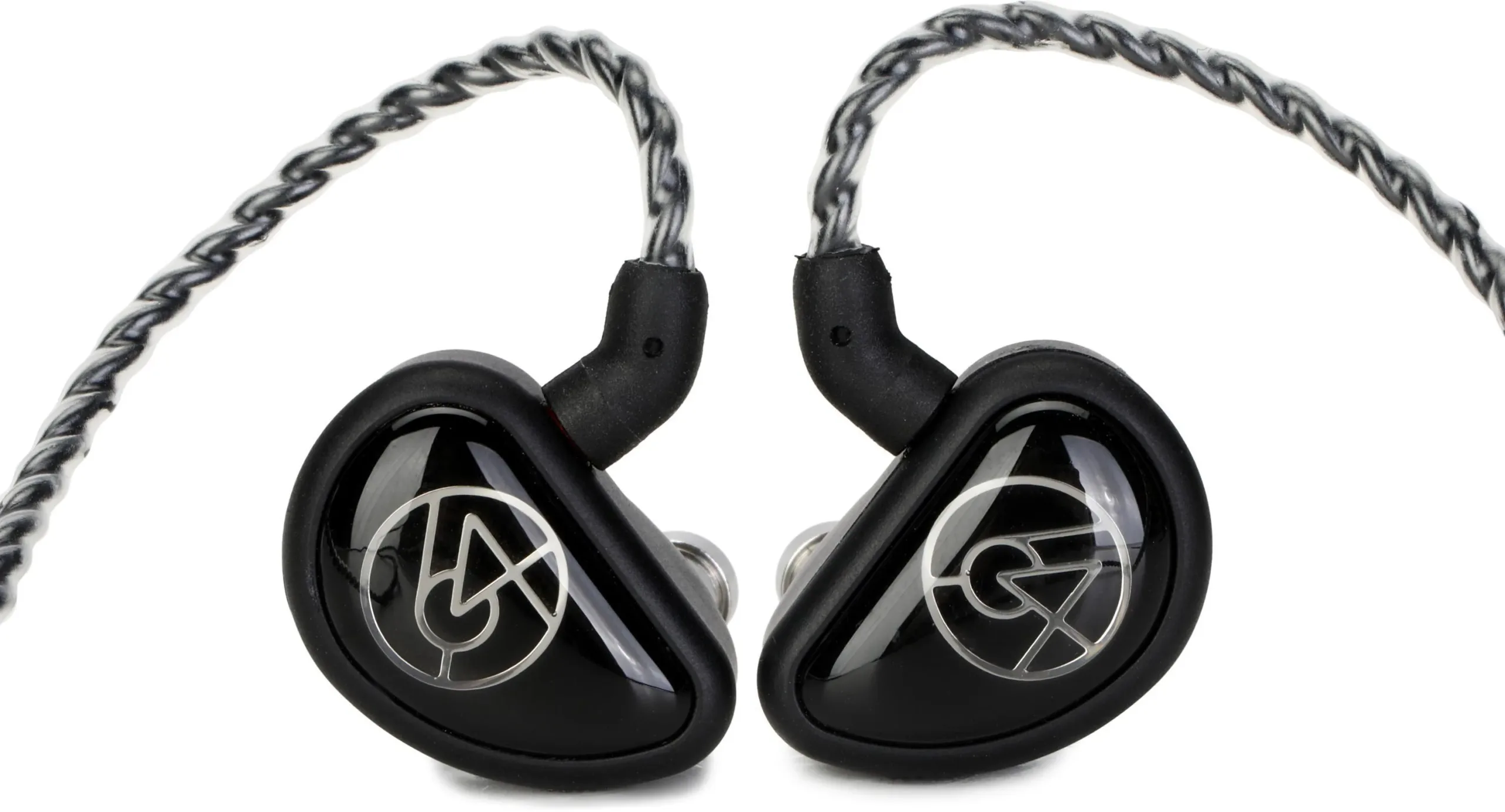
If you’ve been curious about getting into 64 Audio without jumping straight to four-figure customs, the Aspire 4 is the company’s “serious but accessible” universal IEM: a hybrid 1DD + 3BA, four-driver design aimed at working musicians and listeners who want a stage-worthy monitor that still sounds engaging off a phone-sized DAC. It launched at $899 and is now commonly seen around $799 at major retailers.
What’s inside & what you get
- Drivers: 1x dynamic (lows), 2x balanced armatures (mids), 1x balanced armature (highs) with a 3-way passive crossover.
- Specs: 20 Hz–18 kHz, 104 dB/mW sensitivity, 11 Ω impedance, apex core isolation −20 dB.
- Build & accessories: Molded ABS shells, stainless-steel nozzles, detachable 48″ IPX Pro cable (3.5 mm, right-angle), silicone & foam tips (S/M/L), ¼” adapter, cleaning tool, and zipper case.
What that means in practice: the easy-to-drive impedance and healthy sensitivity make Aspire 4 friendly with compact audio interfaces, belt-pack receivers, or dongle DACs—useful on real-world stages and commutes alike. The apex core design contributes to effective passive isolation without the “ear pressure” some sealed IEMs cause.
Fit, comfort, and isolation
The teardrop shells are compact with smooth inner contours; the memory-wired IPX cable helps route over-ear for a secure seal. Isolation is legit: the −20 dB claim aligns with my experience in rehearsal spaces and transit. Tip choice matters—foam gives the most block; silicone lifts treble air and can feel a touch faster. Either way, the apex core venting keeps pressure fatigue low on long sets.
Tuning & sound breakdown
64 Audio pitches Aspire 4 as a musician-forward, mid-present tuning. Across multiple independent reviews, a pattern emerges: authoritative bass from the DD, rich low-mids, tasteful (not sharp) treble, and a stage-useful mid focus that keeps vocals and guitars locked in the mix.
Bass (sub-bass & mid-bass)
The dynamic driver is the star: sub-bass extends cleanly with a mild sense of physicality, while mid-bass has punch that gives kick drums weight without smearing bass guitar lines. It’s “fun but controlled,” with a slightly warm tilt rather than clinical neutrality.
Midrange
This is the focus. Electric guitars, snares, and vocals sit forward enough to cut through stage wash. Some listeners call it warm and full, others note a natural midrange with a gentle pinna notch around ~3 kHz that avoids shout. The trade-off is that you won’t get the hyper-etched separation of leaner, brighter IEMs—but you will get cohesion and body.
Treble
Treble is clean and non-fatiguing—crisp enough for detail on cymbals and vocal air, but polite versus ultra-sparkly audiophile tunings. If you’re treble-sensitive, this balance is pleasing; if you love airy brilliance, you may want to pair with a silver-plated cable or silicone tips to eke out a bit more bite.
Technicalities
- Imaging & stage: More intimate than vast; placement is stable and centered (good for monitoring), not 3D holographic.
- Detail retrieval: Solid for the price tier—macro dynamics and transient punch stand out more than micro-detail fireworks.
- Speed: The DD has snappy attack with natural decay; BA mids keep articulation tidy on dense arrangements.
On stage vs. at home
- Live monitoring: The mid-forward balance and isolation make it easy to track lead vocal pitch, guitars, and snare without cranking the volume. Drummers and bassists will appreciate the sub-bass reach and kick definition.
- Everyday listening: The slightly warm tilt works across genres—indie rock, pop, R&B, worship, and acoustic shine. For classical/jazz detail diggers, the laid-back upper-treble keeps things non-fatiguing, though you might miss a bit of air versus brighter sets.
Source pairing & tips (literally)
- Power needs: With 104 dB/mW @ 11 Ω, most dongles and pack receivers are fine. A neutral-clean source (Fiio KA13/Apple USB-C dongle class) preserves the intended balance; warmer DAPs can make the low-mids a touch too cozy.
- Tip rolling:
- Foam: maximum block, a hair smoother up top.
- Silicone: tighter bass edges, a sprinkle more treble energy.
- Cables: The IPX standard limits easy 2-pin swapping, but aftermarket IPX options exist if you want balanced termination; otherwise, use an adapter at the source.
Build & reliability notes
The matte/soft-gloss black ABS looks understated and doesn’t scream “bling” on stage. Reviewers reported solid QC overall; one noted a cosmetic logo badge issue on a sample, but not systemic. The stainless nozzles feel durable with repeated tip swaps.
Price & value
MSRP: $899, with common retail street around $799 new; open-box deals dip lower. In the current IEM market, that lands Aspire 4 in a competitive “upper-mid” bracket that undercuts a lot of pro-tier customs while delivering stage-ready ergonomics and isolation.
Comparisons & context (within 64 Audio)
Across the Aspire family, Aspire 4 is generally regarded as the most full-bodied and energetic in the bass while keeping mids front-and-center. If you’re chasing a leaner, brighter studio monitor tonality, you might look elsewhere; if you want punch + presence + comfort, Aspire 4 is the sweet spot.
Pros & cons
👍 Pros
- Balanced, musician-friendly tuning with forward mids and punchy DD bass.
- Light, comfortable shells with real-world −20 dB isolation (apex core).
- Easy to drive; plays nicely with compact packs and dongles.
- Complete kit out of the box; stage-ready cable and case.
🤔 Cons
- Treble is polite; airheads may want more sparkle.
- IPX connectors reduce cable-swap flexibility vs. standard 2-pin.
- Soundstage is more intimate than expansive—great for monitoring, less “wow” for head-stage chasers.
Recommended starting EQ (optional, subtle)
- Shelf −1 dB @ 120 Hz if your source is warm and you want a crisper low-end edge.
- Peaking +1.5 dB @ 2 kHz (Q ≈ 1.0) to add a little bite to some vocals/guitars.
- Shelf +1 dB @ 8–10 kHz for extra air if you use foam tips.
These gentle moves echo common reviewer notes while preserving the IEM’s core character.
Verdict
Aspire 4 nails its brief: an honest, stage-savvy monitor with enough musicality to enjoy off-duty listening. The DD slam + mid presence formula makes it a dependable pick for vocalists, guitarists, drummers, and MDs who need parts to pop without cranking volumes. If you value comfort, isolation, and reliable tonality over “wow-factor” theatrics, this is a terrific buy at its current street price.
Leave a Reply