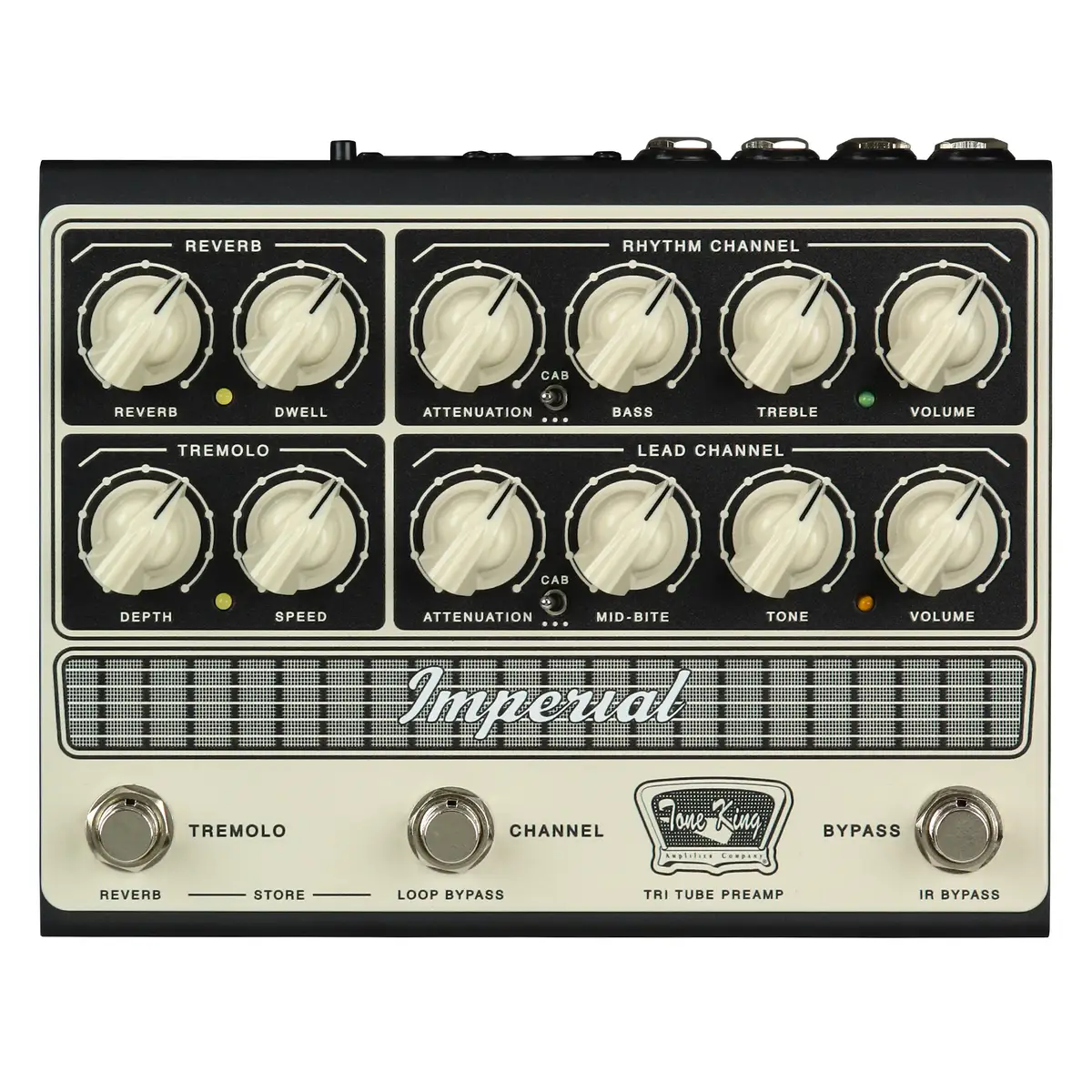
If you’ve ever loved the feel of a cranked Tone King Imperial MKII but wished it lived on your pedalboard (and could go straight to front-of-house or headphones), this is that dream made real. The Imperial Preamp is a high-voltage, tri-tube preamp/amp-in-a-box that lifts the actual Imperial MKII preamp and phase-inverter circuits into a pedal, then adds spring reverb (convolution), bias-style tremolo, IR cab sims, MIDI, stereo outs, and an editor app.
What it is (and why it’s different)
Most “amp-in-a-pedal” boxes are solid-state. The Imperial Preamp runs three 12AX7s at real amp voltages and even includes the phase inverter from the Imperial MKII—Tone King calls this a built-in “zero-watt power amp,” which is key to the pedal’s chewy dynamics and bloom. In short: you’re feeling the same gain structure you’d feel in the combo, just without the speaker pushing air.
Two channels mirror the amp:
- Rhythm: blackface-style cleans with Bass/Treble and Attenuation.
- Lead: tweed to vintage-British grind with Volume, Tone, Attenuation, and the clever Mid-Bite that tightens lows while adding presence/gain.
On top of that you get convolution spring reverb (Reverb & Dwell) and bias-flavored tremolo (Depth & Speed), both footswitchable.
I/O, routing & modern conveniences
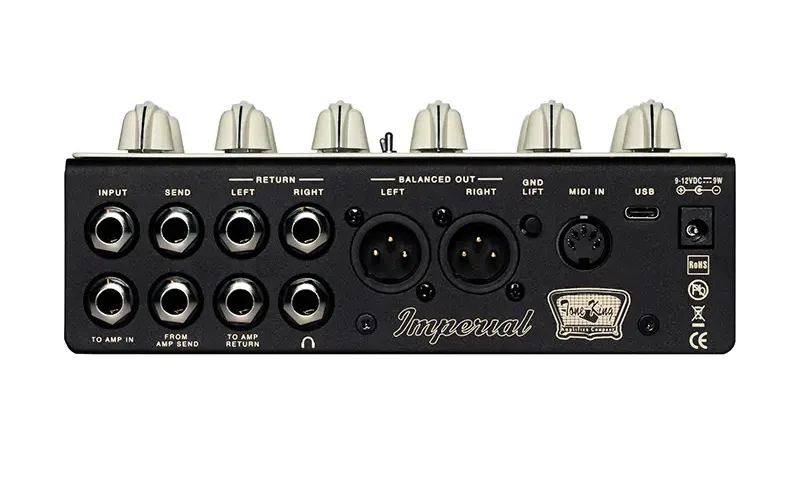
Round back is where it turns into a studio tool:
- Stereo balanced XLR outs with low-latency IRs (per channel) and an IR Bypass footswitch.
- Stereo loop (Send/Return) so your time-based effects sit after the preamp.
- Headphone out, USB for the editor, and MIDI in with up to 128 presets for recall.
This means you can:
- drop it on a traditional board into your amp’s FX return,
- go direct to FOH with IRs, or
- track silently with cans at 2am—no compromises on touch or transient feel.
Controls at a glance
The front panel is wonderfully old-school: three rows of big cream knobs and three footswitches (Tremolo, Channel/Loop Bypass, Bypass/IR Bypass). Each channel also has a 3-way cab selector when using IRs, and both channels include Attenuation for hitting sweet spots at any level.
How it sounds
Rhythm channel: Sparkly, elastic cleans with the familiar blackface scoop. It takes pedals like a champ—mild compressors and transparent drives in front feel “amp-into-amp” rather than pedal-into-pedal. Push the Volume and back off Bass; you’ll get that syrupy edge-of-breakup that chimes, not shouts.
Lead channel: Roll the Mid-Bite clockwise for a tweed-to-British handoff; think woody mids that become snarlier and more focused as you turn it up. It’s not a metal pedal—more Keef than Djenty—but it stacks beautifully with a Klon-style or a RAT for classic rock gain.
Reverb & tremolo: The convolution spring has that bouncy “drip” and never gets plasticky; Dwell lets you go from room-like support to surf wash. Tremolo is pulse-y and vintage, especially after the preamp in the loop.
Real-world setups I liked
- Pedalboard to FOH: Guitar → drives/mods → Imperial Preamp → stereo time-based effects in loop → XLRs to mixer. Use channel IR slots and the cab toggle as your “mic choice.” Fast to set up, shockingly consistent gig to gig.
- Into an amp’s return: Skip IRs; enjoy the amp’s power section and cab. The phase-inverter design makes the feel convincingly “amp-y.”
- Silent studio: USB to editor, headphones out for late-night takes, MIDI to recall favorite clean/crunch/reverb combos instantly.
Who it’s for (and not for)
Perfect for:
- Players who love Imperial MKII DNA and want it direct or on small stages.
- Session folks who need authentic blackface/tweed/brit-ish textures without miking.
- MIDI-savvy guitarists who like preset-based rigs.
Maybe not for:
- High-gain modern metal players (you’ll be stacking additional gain).
- Anyone allergic to tubes/power requirements—this is a real tube preamp and wants proper current.
Price & availability
Street price is around $599/£599/€699 depending on region, available direct from Tone King and major retailers.
Pros & Cons
👍 What I loved
- Feels like an amp under the fingers; not just “good modeling.”
- Two truly distinct channels with Mid-Bite magic on the Lead side.
- Serious I/O: stereo loop, XLRs with IRs, headphones, MIDI.
🤔 Trade-offs
- Bigger and heavier than solid-state preamp pedals (because tubes).
- You’ll want good power distribution on your board.
Suggested starting settings
- Blackface clean: Rhythm Vol 1–2 o’clock, Bass 11, Treble 1, Attenuation to taste. Reverb 9–10, Dwell 10.
- Tweed grind: Lead Vol 2 o’clock, Tone noon, Mid-Bite 1–2 o’clock, Attenuation to taste.
- Lush trem verb: Reverb 11/Dwell noon; Trem Depth 11, Speed 10 for a slow throb. (Use loop for delays.)
These land you in the classic Tone King wheelhouse; fine-tune with your guitar and IR choice. (IR slots and “CAB” switch are per-channel.)
Bottom line
The Imperial Preamp isn’t chasing convenience at the expense of feel—it’s chasing feel and then layering convenience on top. If your sound lives anywhere between sparkling mid-’60s cleans and ragged-edge tweed/early-British breakup, this pedal is a bullseye. For players who record direct, run IEMs, or juggle multiple gigs, it’s one of the most convincing amp-in-a-box experiences you can currently buy.
Leave a Reply